
What is international road freight?
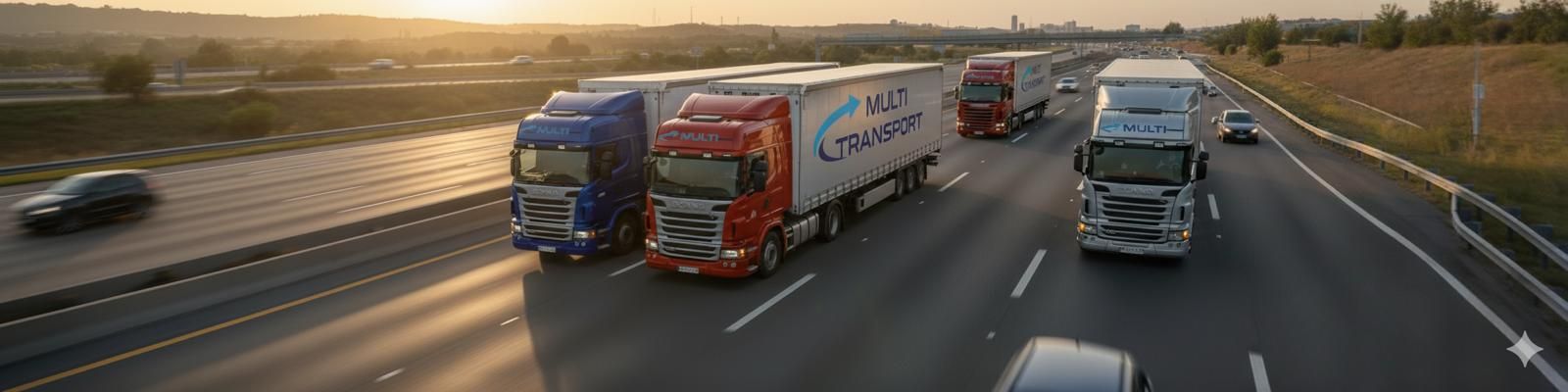
International road freight moves cargo from one country to another by truck or by a smaller commercial vehicle. In most cases the same vehicle carries the goods from the loading address to the delivery address, with no port or airport handover in between. Flexible loading days, a wide choice of destinations and genuine door-to-door delivery make road one of the most widely used modes in Türkiye’s trade with Europe, the Middle East and Central Asia.
We carry export, import and transit loads. On European lanes in particular we run our own tractor units and curtain-side trailers; for other destinations we work through our partner and agency network. Either way, the whole operation, from vehicle allocation and routing to border planning, tracking and delivery, is run from one operations desk.
Which road service fits your load?
The right service depends on the volume, weight and urgency of your cargo and on any special requirements. Use the table below for a quick first choice; each service has its own page with the detail.
| Service | When to choose it | Typical cargo |
|---|---|---|
| Groupage (LTL) | The load does not fill a truck: a few pallets or a few loading metres | Palletised export loads, regular small consignments |
| Full truckload (FTL) | The load fills the trailer, is heavy or has a fixed delivery date | Series production, raw materials, furniture |
| Express (minivan and lorry van) | Small but very urgent shipments | Spare parts, samples, exhibition material |
| Refrigerated | The cargo must stay within a set temperature range | Food, pharmaceuticals, heat-sensitive chemicals |
| ADR (dangerous goods) | The cargo falls into one of the ADR classes | Paints and solvents, aerosols, batteries, lithium cells |
Our own tractor fleet and curtain-side trailers
Running our own vehicles keeps the delivery time in our hands: we decide when the truck loads, who drives it and which route it takes. On European lanes we operate our own tractor units with curtain-side trailers.
A curtain-sider can be loaded from the side, once the curtains are drawn back, as well as from the rear. That makes it a practical choice for palletised general cargo and for long or bulky items that need to be forklifted in from the side. For temperature-sensitive cargo we plan a refrigerated vehicle, and for small urgent consignments a minivan or lorry van. Where a lane or a load calls for vehicles outside our own fleet, we work with our partners, and the operation is still run from the same desk.
Border and transit crossings, monitored
On international road routes, much of the delay happens not on the road but at border gates and in customs. That is why we treat border and transit monitoring as part of the service rather than an extra:
- Transit procedures: through countries in the common transit system the cargo moves under a T1 transit declaration (NCTS); on other routes a TIR carnet is used where needed, so the goods travel under customs control.
- Border gates and routing: waiting times at busy crossings such as Kapıkule, on the Bulgarian border, are built into the plan, and options such as a Ro-Ro link to Italy are considered where the route allows.
- Keeping you informed: arrival at the border, customs formalities and exit are monitored by our operations desk, and you are updated throughout.
How a road shipment works
- Request and quote: send us the origin and destination, cargo type, number of packages or pallets, dimensions and weight, and we come back with a rate and an estimated transit time.
- Service and vehicle: we match the load to the right service (groupage, full load, express, refrigerated or ADR) and plan the vehicle, route, border gate and driver.
- Documents: the invoice, packing list and CMR are prepared; the export declaration and, depending on the destination, an A.TR, EUR.1 or transit documents are arranged.
- Loading: the cargo is loaded and secured according to its declared dimensions and weight.
- Transit and tracking: border and transit crossings are monitored from one operations desk.
- Delivery: once import clearance is complete at destination, the cargo is delivered to the consignee.
How road freight rates are built
There is no one-size-fits-all tariff in road freight. The rate reflects a combination of factors:
- Type of service: a full load is priced per truck; groupage is priced on the space and weight your cargo takes up.
- Dimensions and weight: for groupage, whichever is decisive (weight, volume in m³ or loading metres, LDM) sets the chargeable quantity.
- Route: distance, the countries crossed, motorway, bridge and ferry costs, and border gates.
- Cargo requirements: temperature control, ADR, non-stackable cargo or special equipment.
- Timing: seasonal peaks and the number of trucks available on the lane.
- Customs: the scope of transit and destination formalities.
Which documents do you need?
A standard international road shipment needs a commercial invoice, a packing list, a CMR consignment note and an export declaration. Industrial goods going to EU countries usually travel with an A.TR movement certificate, while goods for countries that have a free trade agreement with Türkiye mostly need a EUR.1; transit movements add a T1 or a TIR carnet. We confirm the exact set your goods and destination need at the quote stage.
Why Multitransport?
- Our own fleet: on European lanes in particular, our own tractors and curtain-side trailers keep the delivery plan in our hands.
- One operations desk: vehicle allocation, driver planning and routing are decided in one place.
- Five services, one contact: groupage, full-load, express, refrigerated and ADR loads are handled by the same team.
- A wide network: scheduled lanes to 54 countries in 8 regions, plus an agency network for destinations beyond them.
- Scale and certification: more than 650 customers worldwide, over 950,000 tonnes carried a year, and ISO 9001, ISO 14001, ISO 27001 and ISO 45001 certified management systems.