
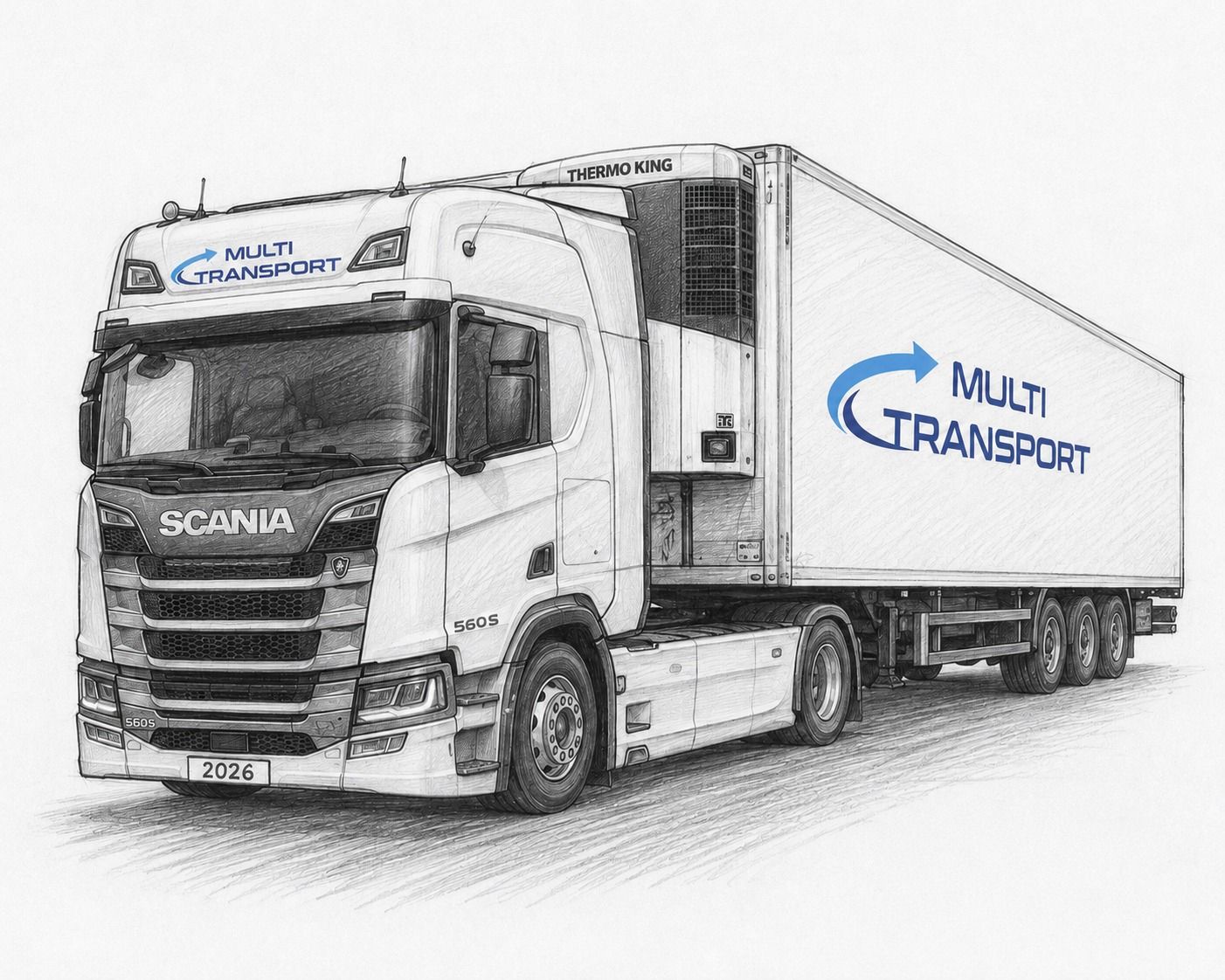
What is refrigerated transport?
Refrigerated (reefer) transport keeps cargo at a set temperature inside an insulated trailer fitted with a refrigeration unit. The aim is simple: from production to delivery, the product never leaves its permitted temperature range, an unbroken process known as the cold chain. Because reefer units can also heat, they protect cargo that must not freeze in winter as well.
One point is often overlooked: a reefer trailer is designed to hold cargo at the temperature it was loaded at, not to cool it down. The product therefore has to be at its required temperature before loading, and the trailer pre-cooled to the set point.
What travels by reefer?
The ranges below are common industry values; the exact set point and tolerance always come from the manufacturer’s carriage instructions.
| Cargo group | Common temperature range | Examples |
|---|---|---|
| Frozen food | −18 °C or colder | Frozen fruit and vegetables, meat, seafood, ice cream |
| Chilled food | Usually between 0 °C and +8 °C | Dairy, charcuterie, fresh meat |
| Fresh fruit and vegetables | Varies by product | Cherries, grapes, figs, citrus |
| Pharmaceuticals and healthcare | +2/+8 °C or +15/+25 °C | Vaccines, cold-chain medicines, medical products |
| Heat-sensitive chemicals | As per product instructions | Some resins, adhesives, paints and coatings |
| Other heat-sensitive goods | As per product instructions | Chocolate and confectionery, cosmetics, cut flowers |
Some dangerous goods, certain organic peroxides for example, are subject both to ADR and to temperature control. We assess these separately under our ADR dangerous goods transport service.
How we protect the cold chain
- Instructions: the product, set point, permitted deviation, packaging and pallet details are taken in writing at the quote stage.
- Vehicle preparation: the trailer’s cleanliness is checked and it is brought to the set point before loading.
- Loading: product temperature is checked at loading; gaps are left between pallets and below the roof so that air can circulate, and doors are kept open as briefly as possible.
- Continuous logging: the temperature inside the trailer is recorded throughout the journey and monitored by our operations desk; the refrigeration unit keeps running during border and customs waits.
- Delivery and report: temperature records are shared at delivery and a cold-chain compliance report is prepared for the shipment.
Preparing your cargo
Protecting the cold chain starts before the truck reaches your door:
- Pre-cool the product: bring it to carriage temperature before loading; a refrigeration unit is not built to pull the temperature of warm cargo down quickly.
- Packaging: use ventilated crates and cartons for fresh fruit and vegetables, and packaging that copes with temperature changes for frozen products.
- Pallets: load the product on pallets rather than straight onto the trailer floor, and plan the pallet height to leave room for airflow below the roof.
- Compatible loads: ethylene-producing fruit such as apples and pears should not travel with ethylene-sensitive products, nor should odour-emitting goods share a trailer with products that absorb odours.
- Written instructions: give us the set point, tolerance and any special conditions in writing, matching the information on the product label.
How reefer rates are built
- Set point: frozen cargo usually needs more unit running time and fuel than chilled cargo.
- Distance and waiting time: the unit keeps running for every hour spent at a border, just as it does on the road.
- Volume and vehicle: whether a full vehicle is needed, and the cargo’s volume and weight.
- Loading and delivery points: every door opening makes temperature control harder and adds time.
- Season: demand for reefer trucks rises at harvest time and through the summer.
- Documents and inspections: health certificates, checks in the destination country and customs formalities.
Documents, ATP and customs
The ATP agreement on the international carriage of perishable foodstuffs requires the foods it covers to be carried in tested, certified equipment of the appropriate class when they travel between contracting countries. We confirm at the quote stage whether your cargo falls under ATP and which class of equipment it needs.
Depending on the product, you may also need:
- a commercial invoice, packing list, CMR and export declaration
- a veterinary health certificate for products of animal origin, or a phytosanitary certificate for plant products
- origin documents: usually a EUR.1 for agricultural products going to the EU, and an A.TR for industrial goods
- temperature records in line with Good Distribution Practice (GDP) for pharmaceuticals
Food and agricultural products may be subject to official checks at the destination country’s border control posts. Complete paperwork shortens the wait at the border and, with it, the risk to the cold chain. For declarations and regulation, see our customs clearance service.
Distant destinations and urgent loads
Where road is not practical for a distant destination, we look at sea freight in reefer containers; for pharmaceuticals and samples where hours matter, at air freight. For full reefer loads, see our full truckload transport page as well.
Why Multitransport?
- Continuous temperature logging: the temperature is on record from loading to delivery.
- Cold-chain compliance report: every shipment’s temperature history is documented.
- One operations desk: vehicle, driver and route are planned in one place, with border waits factored in from the start.
- Paperwork support: health certificates and origin documents are planned before loading.
- Certified management systems: ISO 9001, ISO 14001, ISO 27001 and ISO 45001.