
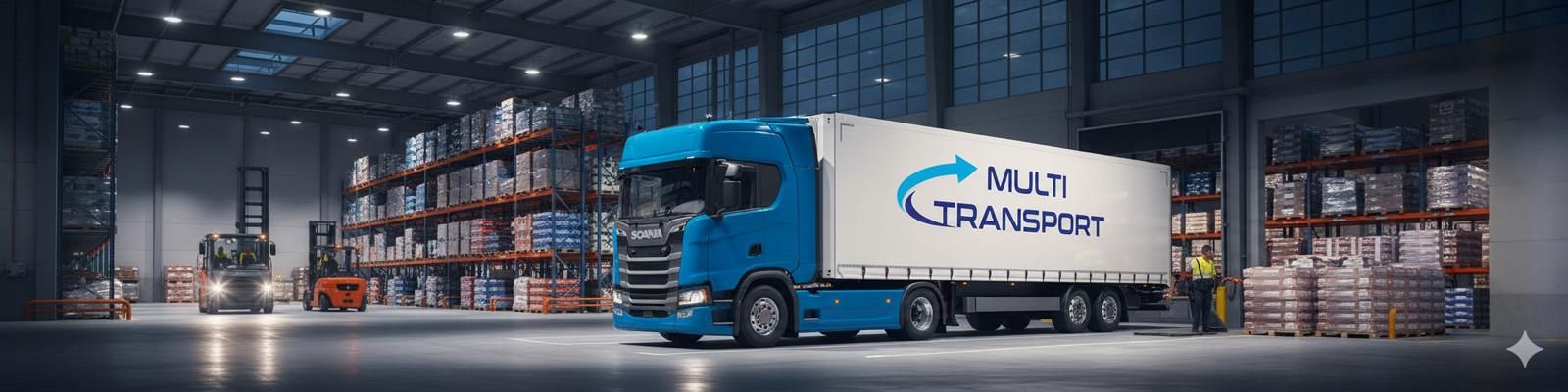
What is groupage transport?
Groupage transport, also called LTL (less than truckload), part-load or consolidated freight, combines loads that would not fill a truck on their own with other consignments heading the same way. Each shipper pays only for the space and weight their own cargo takes up. Because the cost of the truck is shared, groupage is usually the most economical road option for export loads of a few pallets.
In Türkiye the same service is known as parsiyel (part load) or grupaj (groupage): the first word describes the load itself, the second the act of bringing loads together.
Groupage from İzmir
We collect groupage cargo from exporters in and around İzmir, including industrial areas such as Kemalpaşa, Torbalı and Çiğli, so you do not have to send your goods to a consolidation hub in another city first. That saves both the extra haulage and an extra round of handling. Other origins can be arranged on request.
Once its paperwork is ready, your cargo leaves on our scheduled groupage departures together with other loads bound for the same lane.
How groupage works
- Cargo details and quote: tell us the number of packages or pallets, their dimensions and weight, whether they can be stacked and where they are going, and we confirm the rate and the planned departure.
- Load planning: your cargo is added to the load plan for the lane and collected from your address.
- Documents: the invoice, packing list and CMR are prepared; the export declaration and, depending on the destination, an A.TR, EUR.1 or transit documents are arranged.
- Consolidation and departure: consignments are loaded with weight distribution and delivery order in mind, and the truck departs.
- Transit and tracking: border and transit crossings are monitored from one operations desk.
- Arrival and delivery: import clearance is completed at destination and your cargo is delivered to the consignee.
Where we run groupage
Our groupage departures from İzmir cover 54 countries in 8 regions. For routes, customs and documents, go to the page for each region:
| Region | Countries | Worth knowing |
|---|---|---|
| Europe | Germany, Austria, Bulgaria, France, Spain, Switzerland, Italy, Portugal, Romania, Serbia, Greece | Industrial goods for EU countries usually travel on an A.TR; Switzerland and Serbia, outside the EU, mostly use EUR.1 |
| Eastern Europe | Croatia, Czechia, Estonia, Hungary, Latvia, Lithuania, Poland, Slovakia, Slovenia | All EU members; cargo can travel under T1 transit all the way to the destination customs office |
| Benelux | Netherlands, Belgium, Luxembourg | EU members; the Rotterdam and Antwerp area is one of Europe’s main distribution hubs |
| Scandinavia | Denmark, Finland, Sweden, Norway, Iceland, Faroe Islands | Norway, Iceland and the Faroe Islands are outside the EU customs territory and need separate import clearance |
| UK and Ireland | England, Wales, Scotland, Ireland | Since Brexit, the UK needs its own customs declarations; Ireland is in the EU |
| Balkans | Albania, Bosnia and Herzegovina, Montenegro, Kosovo, North Macedonia | All have free trade agreements with Türkiye; origin is usually proved with a EUR.1 |
| Turkic republics | Azerbaijan, Kazakhstan, Kyrgyzstan, Uzbekistan | Long transit routes; a TIR carnet and origin documents depending on the route |
| Middle East | Iraq, UAE, Saudi Arabia, Qatar, Kuwait, Oman, Bahrain, Jordan, Lebanon, Syria, Iran, Egypt | Certificate of origin, plus conformity documents such as SABER or a CoC for some products |
Our Middle East groupage departures are weekly: cargo leaves contracted warehouses in İzmir, Bursa, İstanbul and Mersin and arrives via Cilvegözü in an estimated 12–14 days. For country-by-country detail, Iraq, the Gulf states and Egypt included, see Middle East groupage from İzmir; for the lanes that run from Germany to Spain, see Europe groupage transport. For destinations beyond these lists we find a solution through our agency network.
How groupage rates are calculated
A groupage rate reflects how much room your cargo really takes up in the truck. Three measures are compared, and whichever is decisive sets the chargeable quantity:
| Measure | When it is decisive | Typical cargo |
|---|---|---|
| Weight (kg) | Heavy cargo in a small volume | Metal parts, ceramics, natural stone |
| Volume (m³) | Light but bulky cargo | Textiles, packaging materials, foam products |
| Loading metres (LDM) | Cargo that cannot be stacked, is long or takes up the trailer floor | Machinery, long profiles, pallets that nothing can go on top of |
A loading metre (LDM) is the length of trailer floor your cargo occupies. A pallet that cannot have anything stacked on it uses both the floor beneath it and the space above it on its own, so even a light non-stackable pallet is usually charged by loading metre.
Other factors also shape the rate:
- the destination country and city, and where the delivery address is
- stackability, pallet type and packaging
- special requirements such as ADR or temperature control
- the scope of customs and transit formalities
- seasonal demand and the departure schedule on the lane
Groupage or full truckload?
Cost is groupage’s big advantage; the trade-off is that consolidation and distribution usually make transit longer than with a dedicated truck. If your cargo fills most of a trailer, is heavy or has a fixed delivery date, full truckload transport often becomes the better deal. For small but very urgent consignments, a dedicated minivan or lorry van is the better fit. Not sure? Send us your cargo details and we will price the options side by side.
Preparing a groupage shipment
Because your cargo travels alongside other consignments, good preparation reduces both the risk of damage and the chance of unexpected charges:
- Palletise: spread the load evenly on sound pallets and secure it with stretch film; cartons overhanging the pallet are easily damaged.
- Label: mark every package with the consignee’s name, address and package number (for example 3/12).
- Stackability: if nothing can go on top, say so at the quote stage and mark the packaging.
- Accurate dimensions and weight: if the dimensions or weight at loading differ from those quoted, the rate may need to be reassessed, so accurate details up front avoid surprises.
- Complete paperwork: in a groupage truck, one consignment with missing documents can hold up the whole vehicle at the border, which is why we check each consignment’s paperwork before loading.
Documents and customs
Every consignment in a groupage truck has its own set of documents: commercial invoice, packing list, CMR and export declaration. Depending on the destination you may also need an A.TR or EUR.1 movement certificate, a certificate of origin and, for transit movements, a T1. For help with regulation and declarations, see our customs clearance service.
Why Multitransport?
- Loading in İzmir: your cargo is collected in and around İzmir, with no need to truck it to a distant hub.
- 54 countries, 8 regions: scheduled groupage departures from Europe to the Middle East, planned at one desk.
- A clear chargeable basis: we agree with you at the quote stage whether weight, m³ or LDM drives your rate.
- Paperwork checked first: each consignment’s documents are reviewed before loading, so the truck is not held at the border.
- Certified processes: ISO 9001, ISO 14001, ISO 27001 and ISO 45001 management system certificates.